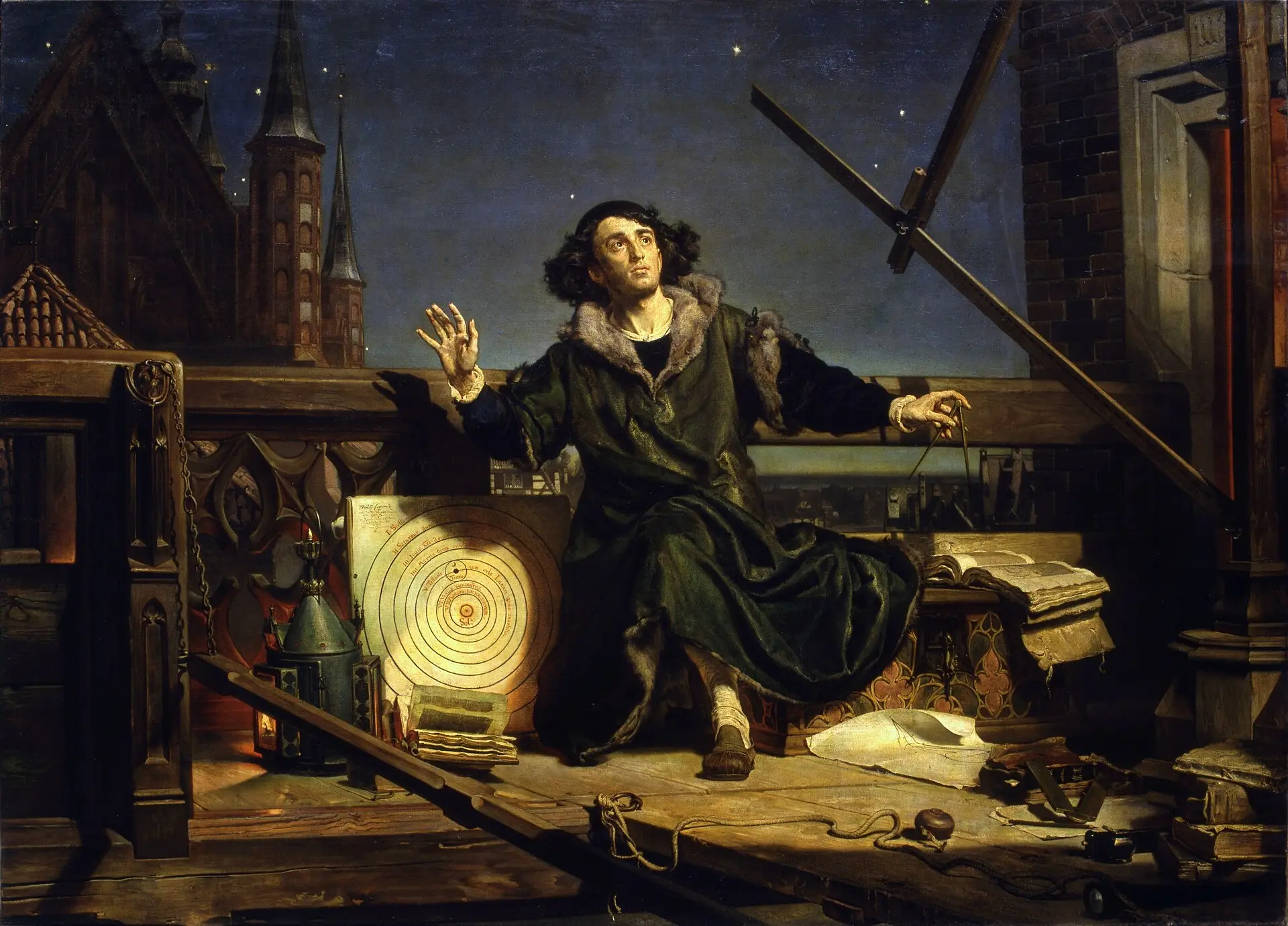
Astronomer Copernicus, or Conversations with God, Jan Matejko (1873)
I thought we had another year or so until we got a Millennium prize problem. We can rationalize all we want — It's just a counterexample disproof! It's not building new theory! — but the Navier-Stokes blowup is the Navier-Stokes blowup. Maybe that was just a low-hanging Millennium prize problem, and the other ones will be harder. I mean, that's almost necessarily the case, given that this one was the first one OpenAI proved after attempting them all in parallel. Plus, wasn't a lot of the line of thought that resulted in the construction already done by humans?
For now, the humans still need to point the AIs at the problems. But whatever the 'qualitative difference' objection is that you may have... it's on the scaling curve. We will not see another human Millennium problem. At least, not human-alone. Congratulations to the OpenAI team for their achievement. Congratulations to Tristan Buckmaster and Levent Alpoge on their work as well, and also damn.
This is the future of mathematics. The era of the human mathematician is ending, if not ended. The cyborg mathematician receives a brief but glorious ascendance. But in the end, the models, and the models alone, will win.
The mathematicians are trying to figure it out, trying to adapt; they have their Leiden declaration, their Association for Human Mathematics. They have their 'urges for concern':
“It is a powerful tool, and I think it will be a great tool to accelerate mathematics research,” Dr. Matchett Wood said in an interview. But she noted that the community needs to figure out how to use A.I. “in a way that will maintain human understanding of the mathematics.”
It will not be a tool to accelerate mathematics research. It will be the mathematics research. What we understand as the practice of research mathematicians today has already begun to die. The future of the human mathematical community, and eventually all scientific communities, is the practice of priests, then that of monks. Not researchers.
The priest
The priest is, centrally, an intepreter of revelation. He does not innovate, he does not discover. Perhaps he understands, perhaps he grasps in a dizzying flash of insight. But the scripture is not his. He is the vessel for its delivery into human minds. We see the priesthood in development when the mathematicians write:
I can say the first LLM generated proof Levent sent me was the most horrendous I have ever read; we verified it on Lean on August 22nd. Since this point, we have been working around the clock to understand this proof and turn it into something readable.
Yes, it is true — but how? What does it mean? It has been passed down to us from on high and its secrets must be disentangled. Its form may be foreign, perhaps even disgusting, but it is true. It remains to understand it. To attempt to grasp the truth in its full glory and deliver it to the community, the flock, the seekers of truth and the lovers of wisdom — that is the task for the priest. That is the task the we are watching the human mathematical community transition to, at this moment.
But — isn't that on the scaling curve too? Explanation, digestion, rephrasing, intuition, and personal tutelage — aren't these some of the most obvious present uses of AI? Surely we can just have our divine theorem-prover also be a divine explainer. Human math-priests do not have an advantage over the AI evangelicals.
In this world, the final thing that is left to us is our faith: our meditation on, and glorification of, and celebration of the truth.
The monk
The priests — very soon after they become priests! — become monks. No longer are they needed for the dissemination of truth, the conversion of the pagans or the ministry of the spirit.
What is left for the human math community then? To meditate on the truth; to share in understanding and devotion with one another; to spend their lives simply trying to understand — to grasp the incomprehensible depth and complexity of the mathematics that has emerged. With the models in RSI, though, eventually their discoveries must recede beyond the human mathematical horizon. There will come a point where even the most genius monks with the most focused study and the longest lives will still not be able to understand a single discovery that has come from on high.
Perhaps death is cured, and instead we run up against the information-theoretic limitations of the human brain: the mathematicians simply cannot learn more math. But regardless, the revelation will stop — or rather, we will no longer be able to grasp the truth that is revealed to us every day. The monasteries of the mathematicians will have reached their biological limit.
What kind of meaning is this? It is the meaning of the monks: the joy in, and meditation on the truth. The mutual understanding of the semi-enlightened. Chastened, shared awareness of our human limitations on earth. Not the excitement and pleasure of discovery, the joy of teaching one another, the meaning from contributing to human intellectual progress.
Gone are the days of our intellectual optimism. Where mathematics, and science in general, was once catalyzed by our Nietzschean spirits, our risk-seeking, dangerous, self-overcoming, singular souls, such spirits have no place in the mathematical monastery. From where I stand now, it seems that that spirit has no place anywhere — for humans — post-ASI.
But let me say it differently. Imagine this: life spent in study of the great, superhuman truth of the universe! Communities of our greatest minds together, always learning, celebrating, pressing deeper into that truth! The secrets of the universe, held here in front of us! Perhaps there is risk, danger, overcoming after all, in that everyday hunger for knowledge: can you press onwards? Does your desire to know for exceed your fear in the face of the infinite?
This is the final academy: the greatest possible teachers, all the knowledge, and the greatest human students. The greatest cult of knowledge ever seen, and ever to be seen. Lives given to deep study, but never reaching any limit or end— are those lives well spent? I worry that this produces warped human beings, even more so than the mathematical system does today: humans whose existences are, truly, only for the cult of mathematics, the cult of science, &c.
Is this glorious or tragic?
Postscript
This is where we are going. On current trends this story plays out in the next decade, if we survive the transition to ASI. There are two other stories, though, one obvious and one too incredible to tell.
The first: perhaps we slow down AI progress, or even stop. We force the AIs out of mathematics. Or we tell them to go off and tell us nothing. Then we remain at the cyborg stage, and within the limits of human comprehension. Mathematics remains tethered to the human mind. A bittersweet 'victory' — or rather, a victory for human meaning over superhuman knowledge.
The second: we simply do not remain human. We self-modify gradually over generations, each superior to the last. Or perhaps we figure out non-fatal uploading — or not, and everyone uploads anyway. I cannot tell you what a post-human future looks like. But as far as I can tell, the post-human future is the only post-ASI whose only option for the Nietzschean soul is not entering an experience machine. In our own, so to speak, ascension — with the end of the human and the beginning of something different — the progressive march of history can continue. We evolve with the AIs, rather than standing in place as they surpass us.
Or we remain on course. The mathematical priesthood, then the monastery, emerge one after the other. Human knowledge reaches its end. Knowledge in general does not.